
The quick answer
Once a year we take your teeth off, clean the side that sits against your gums, check the implants up close and put everything back. Not every practice does this. We do it because that side can't be fully cleaned at home, X-rays alone don't show enough, and problems around implants can grow faster than problems around natural teeth.
In this answer
The side you can't reach
Your new teeth have an outer side and an inner side. The inner side rests on your gums all the time.
A water flosser keeps it in decent shape day to day, but it can't get it fully clean, and you can't floss under fixed teeth. Over a year, buildup collects where no toothbrush reaches.
Why an X-ray isn't enough
X-rays through zirconia can be cloudy and don't always show what's going on. Taking the teeth off lets us see your gums and implants directly.
Why once a year
Each removal works the screws, so doing it too often causes problems of its own. Once a year is enough to catch things early without the visit itself becoming the risk.
Where we go further than the usual guidance
The American College of Prosthodontists' 2016 position statement says removing a fixed, screw-retained implant prosthesis for evaluation isn't needed unless there are signs of peri-implantitis (gum disease around implants), trouble keeping it clean, or a mechanical problem that requires removal. A practice that follows that is doing nothing wrong.
We do it anyway because of what we can and can't see. An X-ray through zirconia mostly tells you things are clearly fine or clearly bad, and little in between. Many older patients can't clean underneath as well as they think. And around implants, a small problem can become a serious one faster than around natural teeth.
Seeing everyone once a year is how we find the occasional person with a problem in time.
Regular care visits and gum disease around implants
Developed peri-implantitis within 5 years
Everyone in this study had early gum disease around their implants at the start. Five years later, people who kept up regular care visits were far less likely to have peri-implantitis.
80 people with early gum disease around implants at the start: 39 had regular care visits and 41 did not. They still had some natural teeth, so these were not full-arch bridges. The visits were regular care, not taking fixed teeth off. So this supports seeing you regularly, not the removal itself. A 2017 World Workshop review also found strong evidence that going without regular care raises the chance of peri-implantitis.
- Costa FO, Takenaka-Martinez S, Cota LO, Ferreira SD, Silva GL, Costa JE. Peri-implant disease in subjects with and without preventive maintenance: a 5-year follow-up. J Clin Periodontol. 2012;39(2):173-81. doi:10.1111/j.1600-051X.2011.01819.x. PMID 22111654.
- Schwarz F, Derks J, Monje A, Wang HL. Peri-implantitis. J Clin Periodontol. 2018;45 Suppl 20:S246-S266. doi:10.1111/jcpe.12954. PMID 29926484.
Start with a free conversation.
What happens at the visit
We start with your health history, since a new medication or a diabetes diagnosis can change our advice.
Then we take the teeth off and check the screws, the connecting parts, your gums and the implants. We take an X-ray and look the teeth over for chips, cracks or a gap against your gums that might need a reline. Then they go back on.
We'll also tap gently on each implant. A solid implant gives a crisp note, like tapping a screw set in hard wood. One that isn't fully joined to the bone sounds dull. Together with the X-ray, a torque check and a good look, that gives us the full picture.
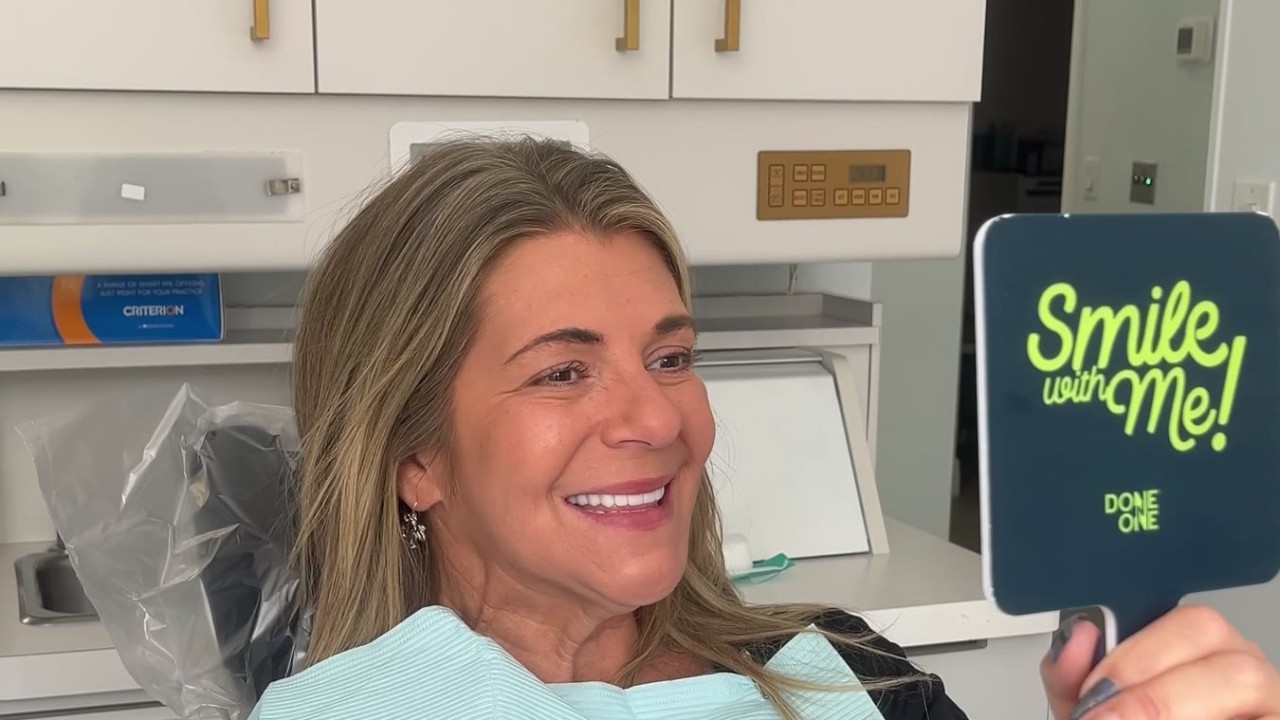
Came in for my annual cleaning and everything went well.
What to ask any practice
Ask whether they take the teeth off to clean them, how often, and whether they have the tools to do it. Look for a practice with a clear plan for looking after you once surgery is done.
What it costs
Under the Lifetime Warranty, nothing extra when you're seen here. Removal, cleaning the underside, checking the implants and gums, and putting the teeth back are all included.
If you'd rather see your own dentist, that's fine and keeps your warranty active, as long as their office sends us records showing the cleaning was done on time. You pay their fee, and the included visit here isn't reimbursed for that year.
Under the two-year cover included with every case, paying for the visit is what keeps the warranty active: $350 per arch, or $700 full mouth. Outside any warranty it's $350 per arch. What each warranty covers is on the warranty page.
We include the visit under the Lifetime Warranty because a checkup people skip over a bill doesn't help anyone. The point is that we see you every year.
Quick answers
Does removing the prosthesis hurt?
No. Your teeth are held on with screws. We loosen them and lift the teeth off. Nothing is cut and you don't need numbing. Putting them back is the same in reverse, with the screws tightened to their set value.
How long does the annual visit take?
About an hour. That covers a health update, taking the teeth off, cleaning them, checking the implants and gums, an X-ray, a quick tap test, and putting them back.
Is the annual visit covered by the Lifetime Warranty?
Yes. Under the Lifetime Warranty, removal, cleaning and the exam are all included when you're seen here. Under the two-year cover included with every case, the visit is billed per arch, and paying for it is what keeps that warranty active.
Hear it on the podcast
Read next
What should a full-arch implant warranty actually cover?
A good warranty covers the things that really go wrong, like chips, breaks, a failed implant and the grafting to replace it, relines, adjustments and X-rays. Our Lifetime Warranty covers all of that, for as long as your membership is active, and it tells you plainly what you need to do to keep it. It's $700 a year for a full mouth ($59 a month), and it includes your annual visit. It renews each year, and we ask two things to keep it running. Keep your annual visit, and hygiene the practice judges adequate.
Answered by Dr. Daniel R. Noorthoek
Read the full answerHow do you clean full-arch implants day to day?
Brush twice a day with a soft brush and a non-abrasive toothpaste, and use a water flosser at least twice a day. That's it. No flossing, and an electric or manual brush both work fine. One patient described it as exactly the same amount of work as before, just in a different order.
Answered by Dr. Blake Hauer
Read the full answerWhat is peri-implantitis, and how is it different from gum disease?
Peri-implantitis is inflammation and bone loss around an implant. It's the implant version of gum disease, and it can move faster. A natural tooth is held in by a ligament and a root layer called cementum. An implant has neither, so the gum holds on less firmly and trouble can build more quickly. That's why your yearly check matters even more once you have implants.
Answered by Dr. Blake Hauer
Read the full answer