
In this answer
The difference underneath
A natural tooth sits in a ligament, and its root is covered in a layer called cementum. Together they hold the tooth firmly and slow gum disease down.
An implant has neither. The gum holds on less firmly, so when a problem starts it can get worse faster.
You usually can't feel it
With gum disease, a tooth usually gets loose. You can feel it wiggle.
An implant rarely does that. Even when it's in trouble, it can feel solid. The signs are bone loss on an X-ray and inflamed gums, and we look for both at your check-up. That's why we keep a regular schedule instead of waiting for something to feel wrong.
What the research found
A 2017 study in Clinical Oral Implants Research looked at 916 implants in 183 patients to see what raised the risk of peri-implantitis. A history of gum disease carried about 2.2 times the risk. Teeth cemented on carried about 3.6 times the risk of screwed-in ones. Teeth showing wear marks on the crown carried about 2.4 times.
Full-mouth cases carried a much higher risk than single implants. That's the reason full-arch patients come back every year.
What went with a higher chance of peri-implantitis
Times as likely, in one study
Two of these three come down to how the teeth are attached and how your bite presses on them. It’s one reason we hold your teeth in with screws and take care setting your bite. In this study, full-mouth cases were the most likely of all to have it. That is why we see you every year.
183 people with 916 implants, placed from 1998 to 2012 at one university center in São Paulo, Brazil. Each implant had been in use for at least a year. This was a one-time snapshot. It shows what went together with peri-implantitis, not what caused it. Cemented teeth are compared with teeth held in by screws. Wear means wear marks on the implant crown. Single implants and full-mouth cases are counted together. Full-mouth cases were 16.1 times as likely to have it as single implants. Figures are as the study summary gives them, with no ranges.
- Dalago HR, Schuldt Filho G, Rodrigues MA, Renvert S, Bianchini MA. Risk indicators for peri-implantitis. A cross-sectional study with 916 implants. Clin Oral Implants Res. 2017;28(2):144-150. doi:10.1111/clr.12772. PMID 26754342.
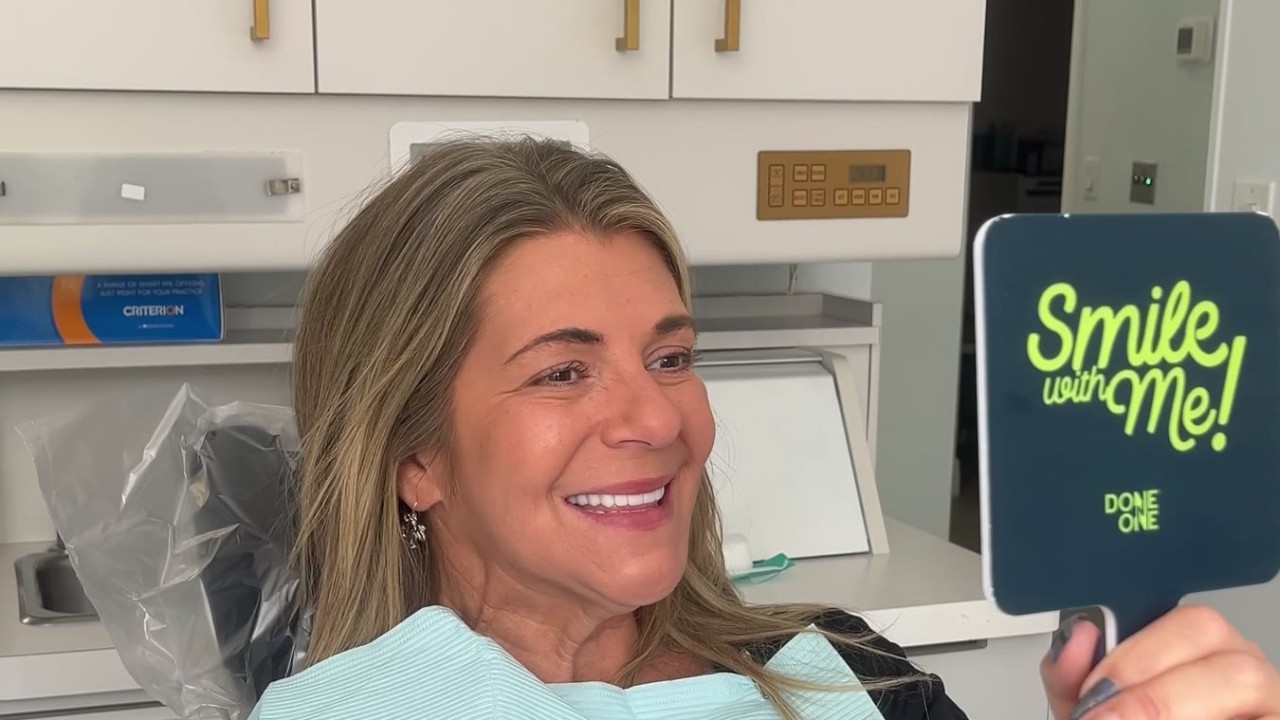
So very happy with the results… I look forward to seeing them all again on my annual cleaning!
How we build your case around it
Some risks come from you, like past gum disease, diabetes or smoking. Others come from how the case is built, like the bite, and whether cement gets left under the gum.
We use screw-retained teeth and take care setting your bite. Then we see you every year, so small problems get caught early.
Quick answers
Will I feel it if an implant is failing?
Usually not. A struggling implant rarely feels loose, so you can't go by how it feels. We find it by looking for bone loss on an X-ray and inflammation in the gums. That's what your yearly visit is for.
Does past gum disease disqualify me from implants?
No. It's a risk factor. It changes how we plan your case and look after it, but it doesn't rule you out.
What is cement-retained versus screw-retained?
It's how the teeth attach to the implants. Cemented teeth are glued on, and extra cement can get trapped under the gum where nobody can see or clean it. In a study of 916 implants, cemented teeth carried about 3.6 times the risk of peri-implantitis of screwed-in ones. We use screw-retained teeth. They can be taken off, cleaned and put back, which is what your yearly visit relies on.
Hear it on the podcast
Read next
What is periodontal disease, and why does it lead to full-arch implants?
Periodontal disease is an imbalance in the mouth's bacteria that goes on for years. Slowly it breaks down the bone, inflames the gums, and loosens teeth until they're lost. It's the most common road to full-arch treatment. Most people who need a full arch got here after years of gum disease that was never treated or never stayed under control.
Answered by Dr. Blake Hauer
Read the full answerWhy does Done In One remove your full-arch teeth once a year?
Once a year we take your teeth off, clean the side that sits against your gums, check the implants up close and put everything back. Not every practice does this. We do it because that side can't be fully cleaned at home, X-rays alone don't show enough, and problems around implants can grow faster than problems around natural teeth.
Answered by Dr. Blake Hauer
Read the full answerCan I get dental implants if I have diabetes?
Yes. And it's one of the few risk factors you can improve before surgery. What matters is whether your diabetes is under control. An A1C between six and seven is a very different picture from an A1C of nine. If yours is high, we'd rather work with your doctor first than rush you into surgery.
Answered by Dr. Blake Hauer
Read the full answer