
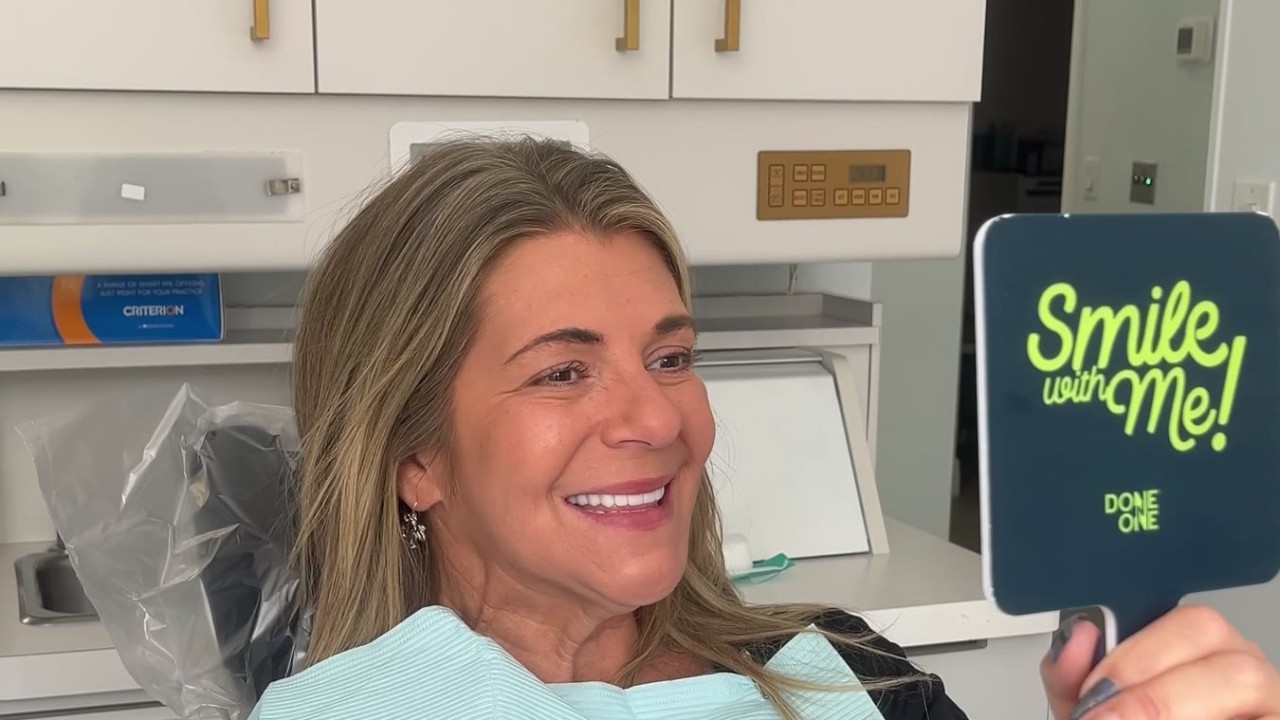
The quick answer
Usually, yes. If your implants are healthy, we can build you a new final set of teeth on them, even though we didn't place them. We call it a refresh. Once it's done, those implants qualify for our Lifetime Warranty. The usual hurdle is the small connector parts, not the implants, and we can solve that far more often than not.
In this answer
Who this is for
More people are in this spot than you'd think.
Maybe you're stuck in a temporary and the final costs more than you were told. Maybe nobody told you the final was a separate cost at all. Maybe you've lost confidence in the practice that started your treatment, or you had it done overseas and can't find anyone nearby willing to touch it. Or your hybrid is fifteen or thirty years old, still working but showing its age.
Or you looked in the mirror the day your temporary went in and felt you'd made a terrible mistake.
We see all of these, often.
What a refresh is
We keep your implants and build you a new final set of teeth on them.
You don't start over, and you don't have surgery again unless something is wrong underneath. It's the same work we do every week, minus the surgery, so there's no recovery for you.
Once you're through it, those implants qualify for our Lifetime Warranty, even though we didn't place them. The Lifetime Warranty is optional and isn't part of the refresh fee. You enroll by the day your final teeth are delivered. It's $700 per year for a full mouth or $350 per year per arch, and cover continues while you keep your annual visit and cleaning with us. Once you're enrolled, if one of those implants fails later, we replace it as if it were our own.
The real hurdle is a small connector
Between your implant and your teeth sits a small part called a multi-unit abutment. Think of it as a translator. Our scanners, milling machines and design files all expect a standard one. Once yours is standard, your case gets a digital file and everything after that is routine.
Before about 2015 there was no standard. Each manufacturer made its own shape. Since then the multi-unit has become close to universal, almost an off-the-shelf part.
So the question is whether we can get you onto a standard connector. Once we can, the rest follows.
What can make it harder
Parts from companies that no longer exist. Old systems and discontinued lines. Sometimes we find a current brand with matching insides that takes a standard multi-unit, and that solves it.
Records we can't read. Notes come in another language, or dates are written differently, so an X-ray we thought was recent turns out to be years old. That changes what we expect to find.
Angles. Multi-units come at set angles and set positions. If the implants were placed without that in mind, the parts may not line up neatly.
Height. Sometimes the implants and abutments are in good shape but the abutments are too tall, leaving too little room for the teeth. Changing them makes a big difference.
Too many implants in the wrong places. Now and then there are more implants than needed and no sensible one to leave out, because they're all in spots that matter and all slightly off.
None of these has stopped a case yet. A few have made one take much longer.
Start with a free conversation.
What to expect
Send us an X-ray and tell us your history. From those two things we can usually tell whether your implants are healthy, which is what matters most. The exact parts sometimes can't be confirmed until we're in there.
Expect one long visit where we take everything apart and see what you have. It's the least exciting appointment, and it's the one that decides everything.
You may go home in your existing teeth for a day while parts are shipped overnight. If that could happen in your case, we'll tell you before you travel.
After that it runs like any other case, and often faster, because there's no surgery or healing to plan around. One patient with thirty-five-year-old implants that were falling apart was done in about three visits.
They fixed a problem I had done somewhere else.
If we find a problem underneath
Sometimes we open a case and find the foundation is the problem. An implant is failing, or it sits where it will cause trouble whatever we build on top.
We'll tell you plainly if that happens. Most people take it well. A few arrive so worn down by what happened before that any bad news sounds like another sales pitch, and we understand why. But putting nicer teeth on a failing implant would leave you paying for a beautiful smile that's back where it started in a couple of years. We'd rather fix the foundation first.
If you're in a temporary right now
One case stays with us. A woman came in right after getting her temporary, knowing at once it was wrong. She found us while there was still a safe window to change the parts, and we got her into her final teeth within it.
She skipped two and a half months of living in something she hated, and all the appointments that would have come with it.
Screws can only be worked a limited number of times while you heal. If you're early in that window and already know something's wrong, call us soon. That clock is the one thing we can't turn back.
Quick answers
My implants were placed overseas. Does that matter?
It makes the parts harder to identify, not impossible. Records sometimes arrive in another language, and now and then the brand is new to us. We've found matching connectors for implants nobody here had seen before.
I'm stuck in a temporary and cannot afford the final where I started. Can you help?
That's the most common reason people come to us for a refresh. If there's still a safe window to change things, call sooner rather than later.
Will my new teeth look like the old ones?
Many people want the same design done properly. Others change it completely. Either is straightforward once the connection is sorted.
Can you quote from my X-ray?
An X-ray and your history usually tell us whether any implants need replacing, which is the big question. The exact parts sometimes can't be confirmed until we take things apart.
Hear it on the podcast
Read next
What are full-arch implant teeth actually made of, and which material is best?
We make one piece of solid zirconia, with nothing bonded on top and no bar underneath. The reason is that every material we used before it failed in the same way - two materials with different flexibility, joined together, eventually come apart. We learned that expensively. One earlier material failed across our whole patient base, we replaced every one at our own cost, and our own co-host was among the patients it failed.
Answered by Dr. Daniel R. Noorthoek
Read the full answerWhat should a full-arch implant warranty actually cover?
A good warranty covers the things that really go wrong, like chips, breaks, a failed implant and the grafting to replace it, relines, adjustments and X-rays. Our Lifetime Warranty covers all of that, for as long as your membership is active, and it tells you plainly what you need to do to keep it. It's $700 a year for a full mouth ($59 a month), and it includes your annual visit. It renews each year, and we ask two things to keep it running. Keep your annual visit, and hygiene the practice judges adequate.
Answered by Dr. Daniel R. Noorthoek
Read the full answerAll-on-4 vs All-on-6: how many implants do I actually need?
Four per arch, in most cases. More implants aren't better. Extra implants sit closer together, reach further back into bone that handles chewing poorly, and each one adds another screw hole through your teeth, which makes them weaker. Adding implants doesn't add teeth, either. We look at your scan before we settle on a number.
Answered by Dr. Daniel R. Noorthoek
Read the full answer