
In this answer
Function first, looks second
Your teeth have to work first. You need to eat comfortably, with a bite that's right and nothing under strain. Looks come second.
A well-made set almost always looks good too. If the two ever pull against each other, your surgeon will tell you, and function wins.
What you get back
The first thing people notice is that nothing moves.
A denture is held by suction, adhesive and your mouth muscles. Fixed teeth are anchored in bone, so biting into something is just biting into it. Most patients say that's the biggest difference.
You also feel pressure and texture again, through the implants and the bone around them. After a few weeks most people stop thinking about it.
If you wore an upper denture, better taste is often a nice surprise. A fixed set doesn't need to cover the roof of your mouth, where a lot of taste and temperature feeling lives.
What's different
A natural tooth sits in a cushion full of nerve endings. That's how you feel a grain of sand in your rice, or know how hard you're biting. Implants join directly to the bone, so that fine feeling doesn't come back.
There's no nerve inside the teeth either, so hot and cold won't register through them.
They'll feel like part of you. They won't feel like the teeth you were born with.
How light a touch you can feel
Lightest touch felt, on average, in grams
On an implant, a touch had to be more than eight times firmer before people felt it. That’s the fine feeling a natural tooth has and an implant doesn’t.
22 people with single-tooth implant crowns, in use for at least a year, all from one implant system. Each was compared with their own natural teeth. These were single implants, not full-arch bridges. A later review of six studies found implants needed a touch about 4 to 20 times firmer.
- Hämmerle CH, Wagner D, Brägger U, Lussi A, Karayiannis A, Joss A, Lang NP. Threshold of tactile sensitivity perceived with dental endosseous implants and natural teeth. Clin Oral Implants Res. 1995;6(2):83-90. doi:10.1034/j.1600-0501.1995.060203.x. PMID 7578785.
- Higaki N, Goto T, Ishida Y, Watanabe M, Tomotake Y, Ichikawa T. Do sensation differences exist between dental implants and natural teeth?: a meta-analysis. Clin Oral Implants Res. 2014;25(11):1307-1310. doi:10.1111/clr.12271. PMID 25279692.
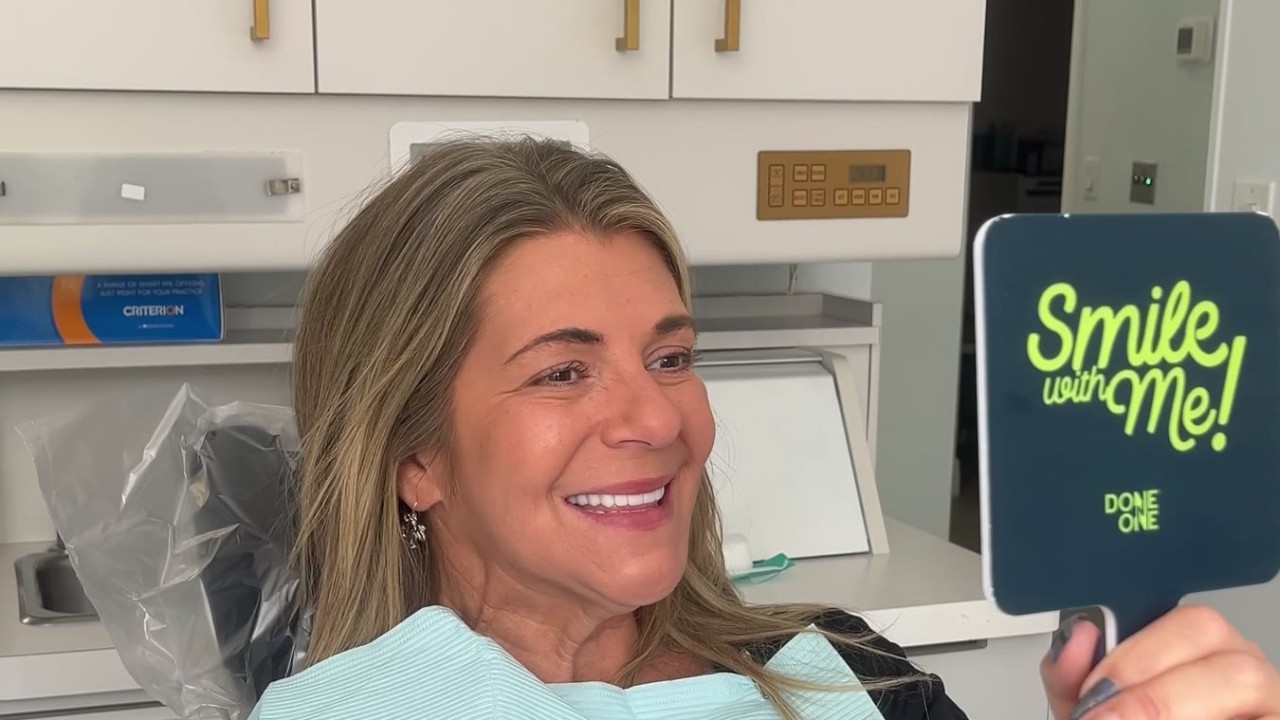
They feel so natural and I’m always getting compliments.
Who this is for
Because implant teeth aren't the same as natural ones, this treatment is for people whose own teeth can't be kept, because of decay, gum disease, fractures or failed dental work. If your teeth can be saved, they should be.
When your teeth are failing, trading a little fine sensation for teeth that work is a very good trade.
About that old photo
Many people bring a photo of themselves from years ago. Please do. It helps us with the shape, width and character of your smile.
We can give you that smile. The face around it has changed with time, so think of the photo as a guide rather than a target.
Quick answers
Will I feel hot and cold?
Not through the teeth. There's no nerve in them, so hot and cold stop bothering you. Many people keep bracing for ice water for months, just out of habit.
Will I be able to feel what I am eating?
Yes, a little differently. You feel pressure and texture through the implants and the bone around them. Most people say it takes a few weeks to adjust, and then they stop noticing.
Will I be able to taste normally?
If you're coming from an upper denture, it's usually better than before. Fixed upper teeth don't need to cover the roof of your mouth, which is where a lot of taste and temperature feeling lives.
Will my speech change?
For a short while. Most people adjust within days to a couple of weeks, and if a sound gives you trouble, we can change the design during your try-in week. People who talk for a living notice it most and adjust fastest.
Hear it on the podcast
Read next
How do you decide what my new teeth will look like?
We decide together, with your new teeth in your mouth. We don't show you a digital mock-up or ask you to pick from a catalog first, because a smile on a screen looks nothing like the same smile in your face. We get the bite and fit right first. Then we spend the rest of the week shaping how your teeth look, with you reacting to the real thing.
Answered by Dr. Sarah Laks
Read the full answerWhat can I eat after full-arch implants? How long is the soft diet?
Soft food for ninety days, starting the day after surgery. The rule is anything softer than a hot dog, or anything you could cut with the edge of a plastic fork. That covers far more than people expect. It's not three months of soup. We also don't want you on liquids. Chewing a little helps your jaw relearn, and it tells us what needs changing while there's still time.
Answered by Dr. Daniel R. Noorthoek
Read the full answerWhat are full-arch implant teeth actually made of, and which material is best?
We make one piece of solid zirconia, with nothing bonded on top and no bar underneath. The reason is that every material we used before it failed in the same way - two materials with different flexibility, joined together, eventually come apart. We learned that expensively. One earlier material failed across our whole patient base, we replaced every one at our own cost, and our own co-host was among the patients it failed.
Answered by Dr. Daniel R. Noorthoek
Read the full answer