The quick answer
Your first fixed teeth go in the day after surgery. They're printed prototypes, so they won't be the color of your final teeth. Your jaw will be sore from holding your mouth open, you'll probably bite your cheek for a while, and your speech may sound odd for a day or two. Each day after that there's a short fitting. You tell us what feels wrong, we change it, and a new prototype is printed.
In this answer
Surgery day
We start with a panoramic X-ray and some before photos from a few angles, using cheek retractors. You'll see a lot of those retractors this week. Then it's on to surgery.
Very few people want their old smile back. Fewer than one in twenty. The photos help us with the things you'd notice if they were missing, like how your lips sit and how full your face looks. Later in the week, if you're trying to describe a shape you half remember, we can look back at them together.
If you have an old photo of your smile from years ago, please bring it. Your own natural smile usually suits your face best, and we'd love to build on it.
The day after: your first set of teeth
We start with a numbing gel. Everyone gets it the first time. After that it's up to you, and some people skip it so they can feel their bite better.
The healing caps come off and your first prototype goes in.
It won't be the color of your final teeth, and that surprises almost everyone. Every prototype is printed in one standard shade, neither yellow nor bright white. The printer holds one resin color at a time, and switching it for each patient isn't practical.
We like it that way, because the neutral shade makes your real teeth look even better when they arrive. One patient told us it was the one thing he wished he'd known ahead of time, and he loved his result. So now you know.
You pick your shade at the end.
What people say on day two
"Do my gums look okay?" They almost always do. Gums heal faster than people expect. A clot forms over each site quickly and acts like a natural bandage.
"I'm biting harder on one side." Very common. That's what the week is for.
"Is this the color?" No. See above.
We get the bite and the comfort right first, then the looks. Once the bite is right, the looks are easy to adjust. It's like deciding where the furniture goes before you paint.
Your speech will sound different for a day or two
Your S sounds will be soft, maybe with a little whistle. That's normal and it passes. It also tells us a lot.
Different sounds check different things. M needs your lips to meet, so it shows us whether the height is right. F and V use your lower lip against your upper teeth, so they show whether the upper teeth sit in the right place. S and T use your tongue against the upper teeth, and a whistle means air is slipping out somewhere.
So when we ask you to say a few words, we're finding what to fix. It isn't a test.
With the older conversion-denture method this was a daily struggle, because there was too much material in the way of the tongue. Now it's usually sorted by the second try-in.
Start with a free conversation.
Little things to know
Bring lip balm. Your mouth is open a long time and your lips get dry. We have petroleum jelly, but bring one you like.
Your jaw will ache, mostly from holding your mouth open, not from the surgery itself. It settles.
You'll bite your cheek. If you've been without back teeth for a while, your jaw has to relearn where everything is. It passes.
Eat soft food, not liquids. Scrambled eggs the morning after is perfect. A little chewing helps your jaw relearn the movement and shows you what to tell us.
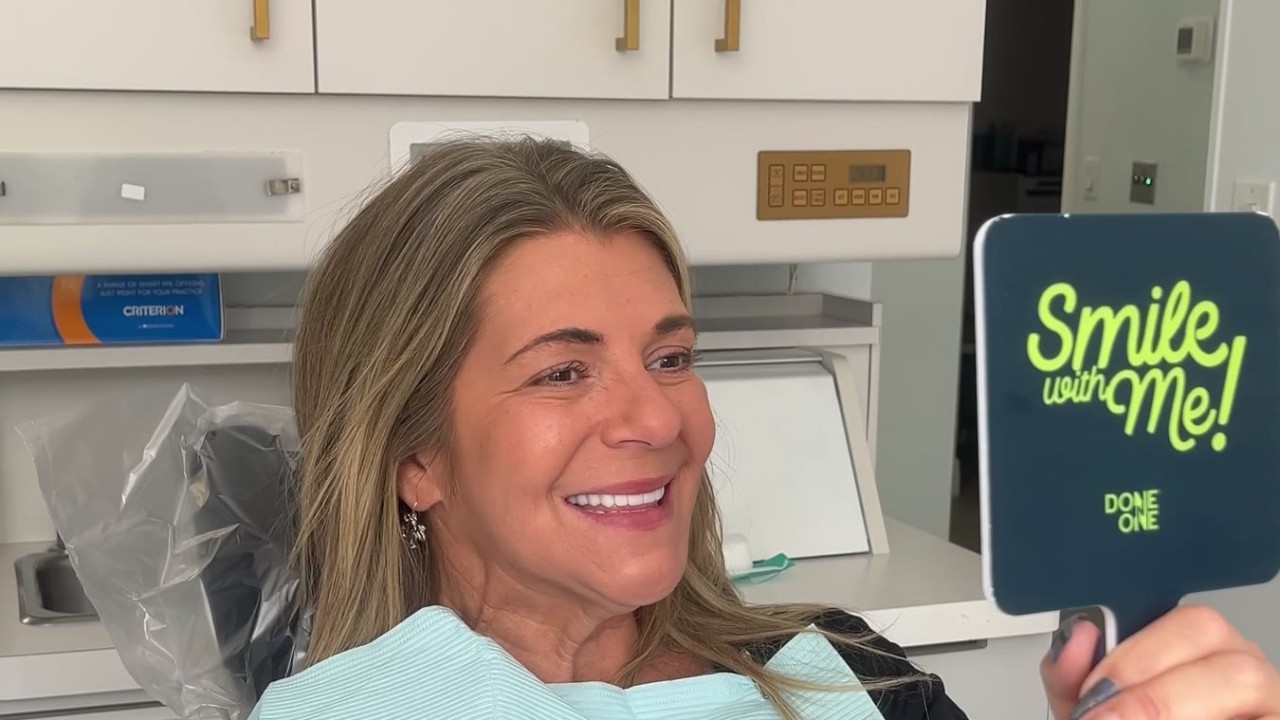
Your face may look a little different for a while. Swelling changes how your lips and cheeks sit. Tell us what you notice. That's what the before photos are for.
If you wore a denture for many years, you may be used to it filling out your lips. Teeth can only do so much there and still be comfortable and easy to clean. Some people choose dermal filler afterward for lip or cheek support. We don't offer it and you don't need it, but it's an option.
The surgery went smoother than I expected, and the recovery was way easier than I had built up in my head.
People experience pain differently.
Your aftercare instructions
Before you leave, your team gives you a written sheet made for your case. It covers medication, swelling, what to do and when to call us.
This page tells you what the days feel like. The sheet is what you follow. If they ever seem to disagree, go with the sheet.
How to think about the week
Nothing you're wearing this week is final. If you don't like something, just tell us.
With older methods, you got one set of teeth and might not be seen again for months, and by then nothing could be changed.
Here, you come back tomorrow. Tell us what's wrong, and we change it.
Quick answers
Why are my temporary teeth this color?
Every prototype is printed in one standard shade, neither yellow nor bright white. That's the printer, and it isn't a preview of your final teeth. You choose your shade at the end, and most people think the real ones look even better next to it.
Should I bring someone with me?
If you can. More than half of our patients do. You've just had surgery and we're asking you to judge your own smile, so a second pair of eyes really helps.
Why does my jaw ache?
Mostly from holding your mouth open so long. We need to see the whole arch at once, so we can't use a bite block. If your jaw still aches months later, tell us and we'll check your bite.
Can filler help if my lip support isn't quite right?
It can. Some people choose dermal filler for lip or cheek support once they've healed, especially if they wore a denture for years. We don't do it and you don't need it, but it's good to know about.
Hear it on the podcast
Read next
Why does Done In One take a week when other offices deliver final teeth in a day?
We could do it in a day. We spend a week to get it right. We were one of the first in the world to offer full-arch surgery to final zirconia teeth within 24 hours as a product to the public, and we still own every machine it takes. We moved to a week because a bite taken right after surgery is rarely right, adjusting finished zirconia teeth can weaken them, and most people can't tell what they want until they see the teeth in their own mouth.
Answered by Dr. Daniel R. Noorthoek
Read the full answerAll-on-4 vs All-on-6: how many implants do I actually need?
Four per arch, in most cases. More implants aren't better. Extra implants sit closer together, reach further back into bone that handles chewing poorly, and each one adds another screw hole through your teeth, which makes them weaker. Adding implants doesn't add teeth, either. We look at your scan before we settle on a number.
Answered by Dr. Daniel R. Noorthoek
Read the full answerHow do you clean full-arch implants day to day?
Brush twice a day with a soft brush and a non-abrasive toothpaste, and use a water flosser at least twice a day. That's it. No flossing, and an electric or manual brush both work fine. One patient described it as exactly the same amount of work as before, just in a different order.
Answered by Dr. Blake Hauer
Read the full answer