
The quick answer
No. Age on its own doesn't rule you out. We've treated patients from their thirties to their nineties. What matters is your health, how you heal and the medicines you take. The question most people are really asking is whether it's worth doing at this stage of life, and we're happy to give you a straight answer to that too.
In this answer
Age isn't what we look at
We've treated people across most of adult life, from patients in their thirties to a patient who was ninety-seven.
What we check is whether your bone will heal around an implant, whether your health and medicines let us plan surgery safely, and whether you can manage the recovery.
A healthy person in their eighties can be a straightforward case. Someone in their fifties with uncontrolled diabetes, a smoking habit and untreated gum disease may not be.
Implants in people 75 and over
Implants still in place, people 75 and over
Still in place at 5 years, by each study’s average age
Age can raise the chance of an implant failing. At one university clinic, implants in people aged 60 to 79 failed about twice as often as in people under 40. Even so, in the oldest groups more than nine implants in ten were still in place after five years.
The 75-and-over figures add together 7 studies at 1 year, and only 3 at 5 years. The age comparison covers 27 studies and 3,892 implants. It groups whole studies by their patients’ average age, not each person by their own age. So it does not show that older people do better. The clinic study covers every patient treated from 1982 to 2003 at one US university clinic. None of these is about full-arch treatment in particular.
- Schimmel M, Srinivasan M, McKenna G, Müller F. Effect of advanced age and/or systemic medical conditions on dental implant survival: A systematic review and meta-analysis. Clin Oral Implants Res. 2018;29 Suppl 16:311-330. doi:10.1111/clr.13288. PMID 30328186.
- Abou-Ayash S, Bjelopavlovic M, Molinero-Mourelle P, Schimmel M. Implant Survival in Patient Populations With a Mean Age of 65-75 Years Compared to Older Cohorts: A Systematic Review and Meta-Analysis. Clin Oral Implants Res. 2025;36(9):1053-1074. doi:10.1111/clr.14456. PMID 40485004.
- Moy PK, Medina D, Shetty V, Aghaloo TL. Dental implant failure rates and associated risk factors. Int J Oral Maxillofac Implants. 2005;20(4):569-77. PMID 16161741.
The question behind the question
Most people who ask if they're too old aren't asking about bone. They're asking whether it's worth the money, and the bother, at this point in life.
It often sounds something like this.
"My dad has a dental issue too, and he's in his eighties, and he's just like - why bother now? I'll be dead in ten years."
That's a fair way to feel, and it deserves a straight answer.
The math most people haven't done
Doing nothing doesn't keep things as they are. Failing teeth break, get infected and come out one at a time. Each of those is another appointment, another bill and another recovery.
So the real comparison is one decision now against a string of them over the same years.
Then there's what those years are for. Ten years of eating what you like, or ten years of working around your teeth. Talking and laughing without a second thought, or not. Most of the difference shows up right away and stays with you.
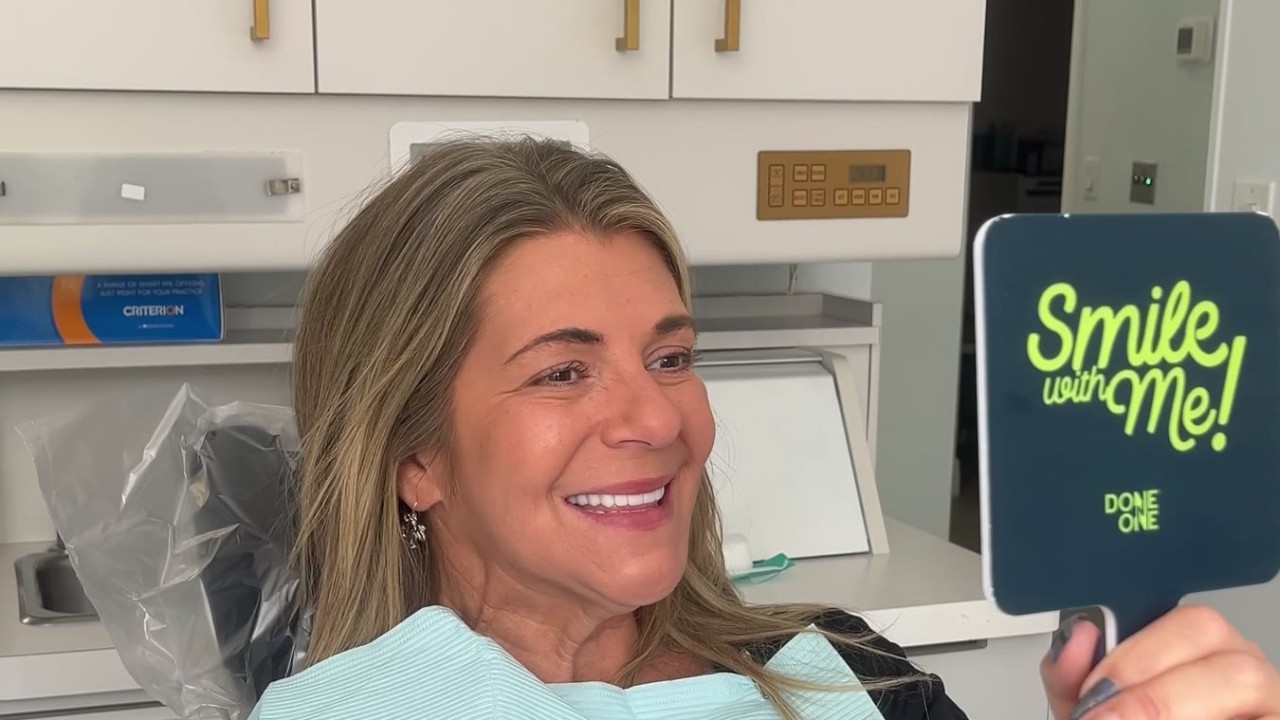
I can not stress enough how happy I am to be finally smiling again and certainly got my confidence back after years of not smiling.
When a denture is the better answer
Sometimes it is. If your general health is poor, if a recovery would be hard to manage, if the cost would change how you live, or if your physician advises against surgery, a well-made denture is a good answer in its own right.
We'll talk that through openly at your consultation.
What to bring
The same things anyone brings.
- Your full list of medicines, including ones you take now and then, and supplements
- Your medical history, especially bone medicines, blood thinners, chemotherapy or radiation
- Someone with you, if you'd like a second pair of ears
A longer medical history just makes the list matter more.
Quick answers
Is there an upper age limit?
Not one based on age. We look at how you heal, your medical history, your medicines and whether you can manage the recovery. It's the same check we do for everyone, applied to you.
Does older bone integrate less well?
Age does raise the risk somewhat. In one large study, patients aged 60 to 79 had about twice the implant failure risk of patients under 40. That same study concluded there are no absolute reasons to rule implants out, and a 2018 review of patients aged 75 and over found implants surviving at about 97% after one year and 96% after five. We see the same thing. We treat patients from their thirties to ninety-seven, and age by itself hasn't been the obstacle. What age changes is your medical picture, your medicines and your healing, and that's what we check.
I am in my eighties. Is it worth it at this point?
That's your call, and it depends more on how you want to spend your years than on how many there are. The section below walks through the math most people haven't done.
Would a denture be more sensible at my age?
It might be. A denture means no surgery and costs less, and for someone in poor health, or who couldn't manage a recovery, it can be the better choice. Getting used to a first denture is hardest for people who've never worn one, so that's worth weighing too.
Hear it on the podcast
Read next
I take medication and have other health conditions. Can I still have dental implants?
Usually, yes. Very few health conditions rule this out. Some change how we plan your treatment, and a few mean we talk with your doctor before we schedule anything. The main ones are blood thinners, osteoporosis and other bone medications, and past chemotherapy or radiation. None of them is an automatic no. Just tell us about them at your consultation.
Answered by Dr. Daniel R. Noorthoek
Read the full answerWhy do people put off getting this done for so long?
We asked, and people gave us six reasons: embarrassment, not having the time, fear of pain, fear of the procedure, money, and the sadness of losing their own teeth. If any of those sounds like you, you're not unusual and you're not late. Most people take years.
Answered by Dr. Daniel R. Noorthoek
Read the full answerHow are full-arch implants different from dentures, and is it worth switching?
A denture rests on your gums and comes out. Full-arch teeth are fixed to implants in your jaw, and you never take them out. What most people notice first is that nothing moves when you eat or talk. No more daily negotiation with a plate that only fits well on a good day.
Answered by Dr. Daniel R. Noorthoek
Read the full answer